
Find Key & BPM
Free MP3 and WAV analyzer that detects musical key, BPM, and Camelot code in your browser
Browser-based tool to analyze audio files and identify their tempo, musical key, and Camelot notation without uploading files.
About this launch
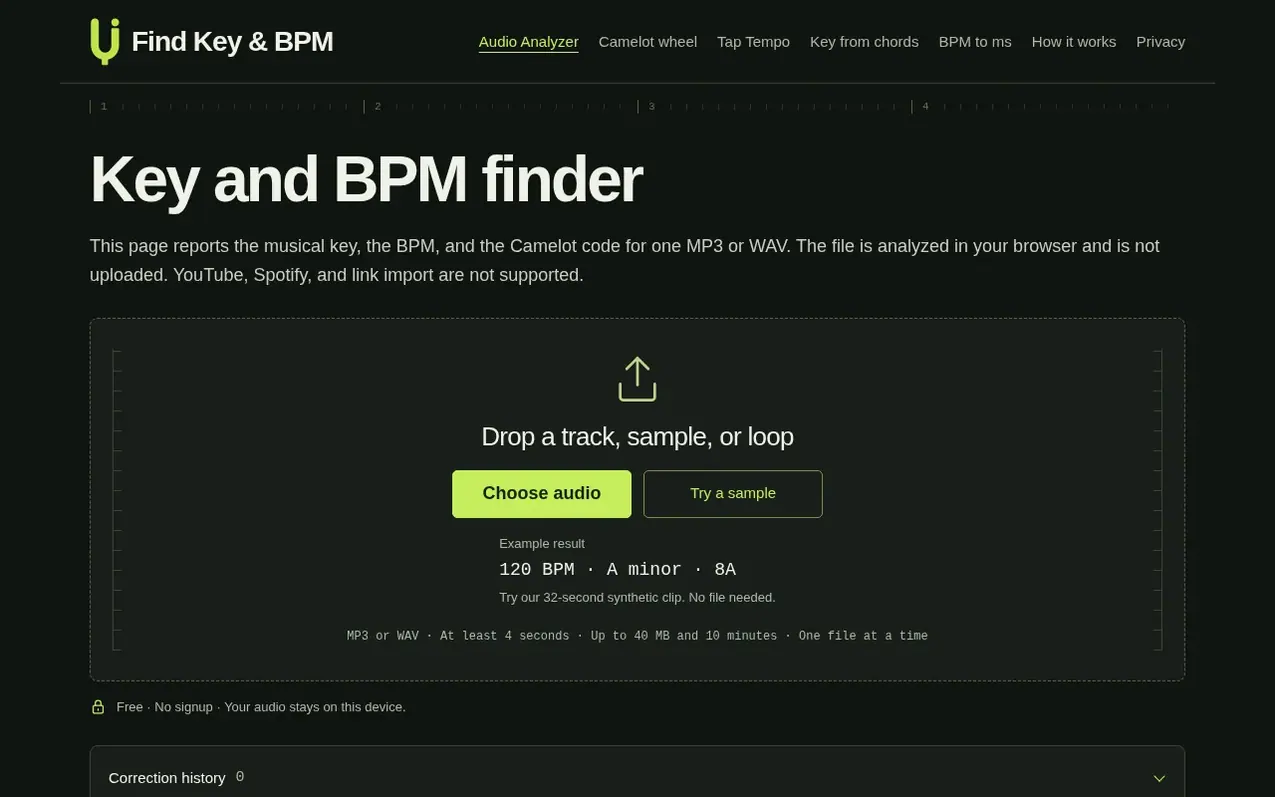
Find Key & BPM is a free web-based audio analyzer that determines the tempo, musical key, and Camelot code of MP3 and WAV files. The analysis runs entirely in your browser without uploading files. It provides tempo candidates in BPM (20-400 range), identifies major or minor keys, and generates Camelot codes for DJ use. The tool includes features like a tap tempo counter for manual beat counting, a key finder for chord-based identification, and a BPM to milliseconds calculator. It shows multiple candidate results for ambiguous audio and allows users to correct and save their findings locally.
What it does
- Analyze MP3 and WAV files up to 40 MB and 10 minutes long
- Display multiple key candidates with confidence scores
- Tap tempo counter for manual BPM verification
- Half and Double tempo options to verify different pulse counts
- BPM to milliseconds calculator for delay time conversion
- Camelot wheel tool for comparing related keys
- Browser-based processing with no file upload required
Pricing
Pricing model: Free
Shopper questions
What audio formats does Find Key & BPM support?
The tool analyzes MP3 or WAV files that are at least 4 seconds long, up to 40 MB and 10 minutes in duration. Mono or stereo files work, and YouTube, Spotify, or link imports are not supported.
Does Find Key & BPM upload my audio files?
No. Audio is decoded and analyzed locally in your browser, and your audio and filename are never uploaded by the tool. Only when you voluntarily submit a correction does the system send the audio identifier and feedback to the server.
What is a Camelot code and how does it relate to musical key?
Camelot is an alternative notation for musical keys used in DJ libraries. A minor is shown as 8A and C major as 8B, with numbers running from 1 to 12 and letters indicating minor (A) or major (B). The selected key and its Camelot code are automatically synchronized.
Why does the tool show multiple tempo or key candidates?
Music can have more than one plausible tempo or tonal center. Sparse audio, changing arrangements, and relative major and minor keys can make automatic analysis uncertain, so the tools show candidates rather than guarantee a single correct answer.
What happens if a song changes tempo or key halfway through?
For files longer than 90 seconds, the tool samples 30-second sections from the beginning, middle, and end but does not build a tempo map or mark key changes. If a song changes, export the sections you need in your audio editor and analyze them separately.
Find Key & BPM has a free listing. The owner can unlock the full profile with a paid launch for $5:
- Founder story (locked)
- Milestones (locked)
- Demo video (locked)
- Dofollow website link (locked)